
Black Friday deals 2026: How to stay on budget

A good Black Friday deal feels like a win. Black Friday deals could also push a holiday budget off course. Black Friday 2026 falls on Friday, Nov. 27, the day after Thanksgiving. A plan made before the sales start could help you buy what's on your list and leave the rest on the shelf. Achieve has some suggestions.
Key takeaways:
- Black Friday 2026 is Friday, Nov. 27, and Cyber Monday is Monday, Nov. 30.
- Credit cards with a grace period charge no interest on new purchases when you pay the full statement balance by the due date.
- Under FTC guidance, a store's "was" price should be one it charged for a reasonably substantial period. Jot down prices earlier in the year to know whether a deal is real on Black Friday.
When is Black Friday 2026?
Black Friday 2026 is Friday, Nov. 27. Federal law sets Thanksgiving on the fourth Thursday of November, which puts the holiday on Nov. 26 this year. Black Friday is the next day, and Cyber Monday follows on Nov. 30.
The five days from Thanksgiving through Cyber Monday draw a big crowd. In 2025, a record 202.9 million people shopped during that stretch, according to the National Retail Federation. Shoppers who made a holiday purchase that weekend spent an average of $337.86.
How to build a Black Friday budget
Start with a dollar amount, not a list of sales. Your budget is the total you could pay in full when the credit card statement arrives.
- Set a total. Do your best to rely on money from your monthly budget or holiday savings, not on credit cards, cash advances, or BNPL loans.
- Give each person or item a limit. Write every name or item on your list with a dollar amount beside it. A price limit turns "That's a good deal" into "Is that on the list?"
- Record each purchase. Use a budgeting app or a simple spreadsheet to keep track of what's left after every order.
- Hold back a little. Leave room for costs like delivery fees and gift wrap.
If cash helps you stop at your limit, envelope budgeting is a way to set a fixed spending limit for each category.
How to tell if a Black Friday deal is a real discount
A sale price is a deal only when you compare it with what the item usually costs. The Federal Trade Commission's Guides Against Deceptive Pricing say a former price should be one the retailer "openly and actively offered" for a reasonably substantial period of time. If the tag shows a red slash through a higher price that the item rarely sold for, the true discount is hard to decipher.
These checks could help you separate real discounts from markups:
- Write down prices now. Note the current price of each item on your list before Black Friday. That number is your baseline.
- Compare identical items. Match the model number, size, and any bundled extras before you compare prices across stores.
- Read the return policy. Return windows and fees differ by retailer, and some sale items have their own rules.
- Skip what isn't on your list. A dinosaur-shaped ladle at 70% off might be a great deal, but it still costs money you hadn't planned to spend.
Store emails and loyalty programs sometimes give members early access to sales. Sign up for the stores that carry items on your list. If you’re sometimes susceptible to impulse buys, explore these tips to kick overspending to the curb.
Should you use buy now, pay later on Black Friday?
Buy now, pay later (BNPL) plans split a purchase into a set number of smaller payments. In a Federal Reserve survey of U.S. adults conducted in October 2025, 16% had used BNPL in the prior year. Eleven percent of BNPL users had a BNPL payment trigger an overdraft or non-sufficient funds fee from their bank.
Each BNPL plan has its own payment dates, so several plans at once could be hard to track. Before you use one, add every payment to your budget by date. Check the plan's terms for late fees and for how returns and refunds work. For many buyers, buy now, pay later is too good to be true. What you can’t afford today might not be affordable in a couple of weeks. That’s for you to review and decide.
What a Black Friday credit card balance could cost
Credit cards with a grace period don't charge interest on new purchases when you pay the full statement balance by the due date.
If you do carry a balance, you’ll pay interest. Credit card annual percentage rates (APRs) tend to be among the highest when compared with other ways to borrow.
Here's what a $1,000 Black Friday balance could cost at 22%:
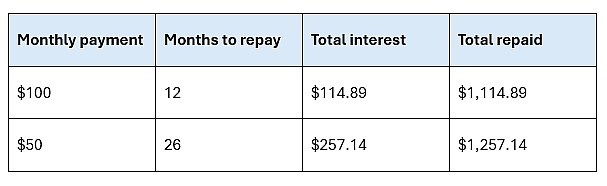
This example assumes no new purchases or fees. Your card's rate and terms could differ.
If you already carry a balance, think carefully before you add new debt for holiday spending. There are many ways to pay off credit card debt, and tackling that challenge could be more rewarding than spending money on holiday expenses.
Black Friday deals go further when the plan comes first. Set your total before the sales start and check each price against the one you wrote down before the sale. Count every BNPL payment and card balance in that total, too.
This story was produced by Achieve and reviewed and distributed by Stacker.


