
Governor McMaster hosts USCB Pritchards Island Research Update
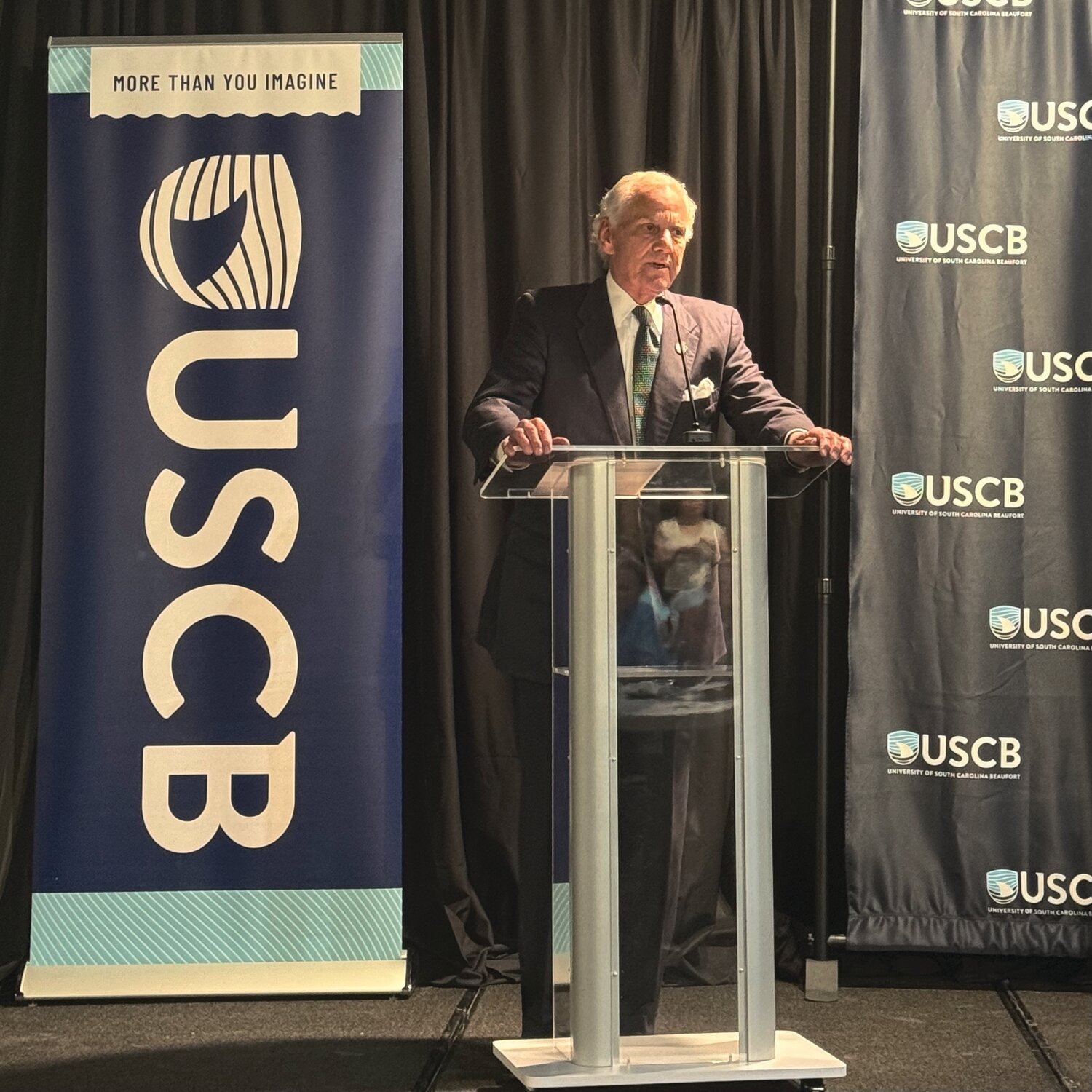


More than 200 conservationists, scientists, community leaders and government officials gathered on November 13 at Tabby Place in Beaufort to hear Governor Henry McMaster and USCB biologists tout the research underway on Pritchards Island.
The university owns this 1,600-acre barrier island—untouched by development and located 25 miles east of Beaufort—that has become a focal point for students and scientists exploring coastal resilience and marine ecosystems.
At the “Return to Pritchards Island” research update, USCB Chancellor Al M. Panu and Warren Parker, executive director of the Pritchards Island Research and Living Shoreline Coalition (PIRLS), recognized McMaster for his pivotal role in securing the island’s future. PIRLS co-sponsored the event.
McMaster successfully secured state funding — $1 million to date — which has allowed USCB to use Pritchards Island intensively for educational purposes. Because half of the nation’s salt marshes are located in South Carolina and many in Beaufort County, Pritchards Island is an unparalleled resource for studying coastal environments.
“It’s like going back to the Garden of Eden,” McMaster said.
Sea Turtles, Marine Worms and more
Dr. Kim Ritchie, associate professor of genetics and prokaryotic cell biology and director of Pritchards Island Research, said the 2.5-mile-long island is a living laboratory. There, she and her students are studying the differences between pristine barrier islands and those where beach renourishment and other interventions take place. They also monitor loggerhead turtle nesting on Pritchards Island and are studying temperature in turtle nests and loggerhead maternal DNA.
“We are on Pritchards every day during nesting season,” Ritchie said.
Ongoing protection efforts for nesting loggerhead sea turtles will continue, with input from community volunteers who have monitored nests on Pritchards Island for years. These efforts are supervised by the S.C. Department of Natural Resources.
Opportunities on Pritchards Island have helped grow USCB’s marine biology program from six students in 2020 to 116 this fall. USCB faculty and students are exploring topics ranging from shoreline erosion and oyster reefs to invasive species and the behavior of marine organisms. Projects include:
• Dr. Edward D’Antonio, professor of biochemistry and structural biology, is examining marine worms that may have the potential to clean up industrial chemicals.
• Dr. Eric Montie, with the help of undergraduate lab assistants, is using acoustic recorders to study undersea soundscapes.
• An anonymous donor has pledged $100,000 to fund a study of migratory and resident shorebirds.
• Dr. Tye Pettay and Jake Zadik are using motion-activated cameras to photograph reptiles and amphibians.
• Lydia Moore, Research and Education Coordinator at Palmetto Bluff, is surveying bats.
Marine biology professor Mercer Brugler captivated attendees at the event with a lively demonstration of how marine organisms hitch rides on floating trash. He also thanked McMaster because the university now has a boat and kayaks. In the past, Brugler used his father-in-law’s pontoon boat to take students to Pritchards Island.
These students have embraced the hands-on opportunities, describing their work as life-changing. Biology student Matty Holt, who studies sea turtles, called Pritchards Island “incredible.” Fellow student Taylor Desilva said her experiences have inspired her to pursue a conservation-focused career.
Prtichards Island is boosting USCB’s reputation for academic excellence. Pettay, who is director of USCB’s Water Quality lab, told the audience that the opportunity to conduct research on Pritchards Island is attracting prestigious scientists to the university. To take larger groups to Pritchards Island, USCB wants to build a dock on the back side of the island and buy a bigger boat.
The “Return to Pritchards Island” event also was an opportunity for USCB to thank the Rhodes family. Philip Rhodes donated Pritchards Island to the University of South Carolina in the 1980s. His son Stephen Rhodes and granddaughter Martha Rhodes have been instrumental in helping USCB access and understand this unique island.
Once a thriving hub of scientific discovery, Pritchards Island fell out of favor as a research and education site for USCB for more than a decade due to funding challenges, erosion that destroyed a lab on the island, and logistical issues. The renaissance of USCB research on the island is a direct result of the S.C. legislature’s decision to include recurring funding for the island in the state.
How You Can Help?
USCB has established a donor fund to support research on Pritchards Island. For more information about the fund, visit USCB.edu/pritchardsisland or contact Tim Daniels, USCB Assistant Vice-Chancellor for Development and Alumni Relations, at tdaniels@uscb.edu.
Carol Weir is the Senior Director of Communications for the University of South Carolina Beaufort in Bluffton, weirc@uscb.edu


